

Busway is commonly manufactured in sandwich-style or air-insulated construction. Sandwich busway places conductors closely together in a compact housing, while air-insulated busway uses spacing between conductors and enclosure walls to manage insulation and heat dissipation.

What Is Busway in Electrical Systems?
Busway is a prefabricated electrical distribution system that delivers power through enclosed conductors within a protective housing.
This page explains what busway is, how it compares with conduit and bus duct, the main types of busway systems, and the NEC Article 368 and UL 857 standards that define busway in the United States.
Why Use Busway Instead of Conduit?
Busway is often chosen over conduit when facilities need faster installation, cleaner overhead routing, and greater flexibility over time.
Because busway is prefabricated and modular, it reduces field wiring labor and makes it easier to extend, modify, or reposition power distribution as equipment layouts change.
Key advantages of busway systems:
- Faster installation — reduces field labor and wiring time
- Modular construction — supports phased builds and future changes
- Compact overhead distribution — uses less space than conduit and cable trays
- Enclosed design — supports safe, code-compliant installation
- Lower lifecycle cost — simplifies future changes and upgrades
Modern systems such as Track Busway build on these advantages by providing continuous plug-in access along the run. That allows power drops and devices to be positioned exactly where needed, rather than being limited to fixed connection points.


Busway Systems: Types, Standards, and Applications
For additional installation scenarios, configuration examples, and system overviews, visit the Track Busway Video Library →
This overview introduces how busway systems are assembled, supported, and applied in real installations. It also helps explain the difference between feeder busway, plug-in busway, trolley busway, and modern open-slot Track Busway.
- Learn how Track Busway provides continuous plug-in access along the run
- Explore plug-in devices and power drops used for flexible equipment connections
- Compare traditional and modern systems in our Track Busway comparison guide
-
Busways distribute power through enclosed busbars within a protective housing. In commercial, industrial , and data centers, busway provides a modular alternative to traditional conduit-based wiring, enabling faster installation, cleaner layouts, and easier long-term modification.
In the United States, busway is governed by NEC Article 368 and UL 857.
Busway systems are commonly used in facilities that require scalable overhead power distribution, cleaner installation, and the ability to adapt layouts over time. They are typically categorized into feeder busway, which distributes power from upstream equipment, and plug-in busway, which allows connections along the run using tap-off units.
More advanced systems such as Track Busway provide continuous access to power along the run, supporting flexible layouts without rewiring.
-
Key advantages of Busway:
Busway systems provide flexible overhead power that adapts as facilities change, with open-slot Track Busway offering continuous access along the run.
- Power can be distributed along the run instead of fixed locations
- Systems can expand without redesigning the entire layout
- Installation is faster than traditional conduit systems
- Layouts can adapt to changing equipment without rewiring
Common applications include:
- Manufacturing and assembly lines
- Warehousing and logistics facilities
- Data centers and labs
- Retail and commercial environments
Why Track Busway
Busway vs Bus Duct vs Busbar vs Conduit
Busway, bus duct, busbar, and conduit are closely related terms, but they refer to different parts of how electrical power is distributed.
At a high level, busbars are the conductors that carry current, while busway and bus duct describe enclosed systems that distribute that power. Conduit, by contrast, is a field-installed method that routes individual wires.
The comparison below highlights how each approach differs in construction, flexibility, and typical use.
| Distribution Method | Description | Typical Use |
|---|---|---|
| Conduit | Field-installed raceway containing individual conductors routed to loads and equipment. | Branch circuits and custom field wiring layouts |
| Busbar | Solid conductor used inside electrical equipment such as switchgear and panelboards. | Internal power distribution within equipment |
| Bus Duct (Feeder Busway) | Enclosed busbars used to move large amounts of power between major electrical equipment. | Electrical rooms and backbone distribution |
| Plug-In Busway | Busway with tap-off points at fixed intervals, allowing plug-in units only at designated locations. | Distributed power where layouts remain relatively fixed |
| Track Busway | Continuous open-slot busway that allows plug-in devices to be installed anywhere along the run. | Flexible overhead power distribution in dynamic environments |
Major Types of Busway Systems Used in Commercial and Industrial Design
Busway systems appear in several forms, each designed to support different electrical distribution needs. Some systems move large amounts of power through buildings, while others allow plug-in access along work areas where equipment connections may change over time.
Modern facilities increasingly favor modular distribution systems that allow equipment to be repositioned without extensive rewiring. The sections below explain the four primary types of busway systems commonly used in commercial and industrial design.

Open-Slot Track Busway
Modern Plug-In System
Open-slot track busway is the modern evolution of plug-in distribution. Instead of fixed tap windows, the system provides continuous access along the entire length. Devices can be added or repositioned anywhere without tools, rewiring, or downtime. Because of its scalability, safety compliance, and fast installation, open-slot busway is widely used today in industrial, lab, R&D, manufacturing, and commercial environments.

Trolley Busway
Sliding Trolley Systems
Trolley busway systems distribute power using a sliding trolley mechanism that repositions power drops along straight runs. While effective for tool rails and linear work areas, trolley systems are limited to single-row layouts and do not support interconnected or grid-based designs common in modern facilities.
For facilities that require multi-directional layouts, frequent reconfiguration, or expandable power distribution, open-slot track busway replaces the limitations of trolley systems by providing continuous plug-in access across interconnected runs

Feeder Busway
High-Amperage Busduct
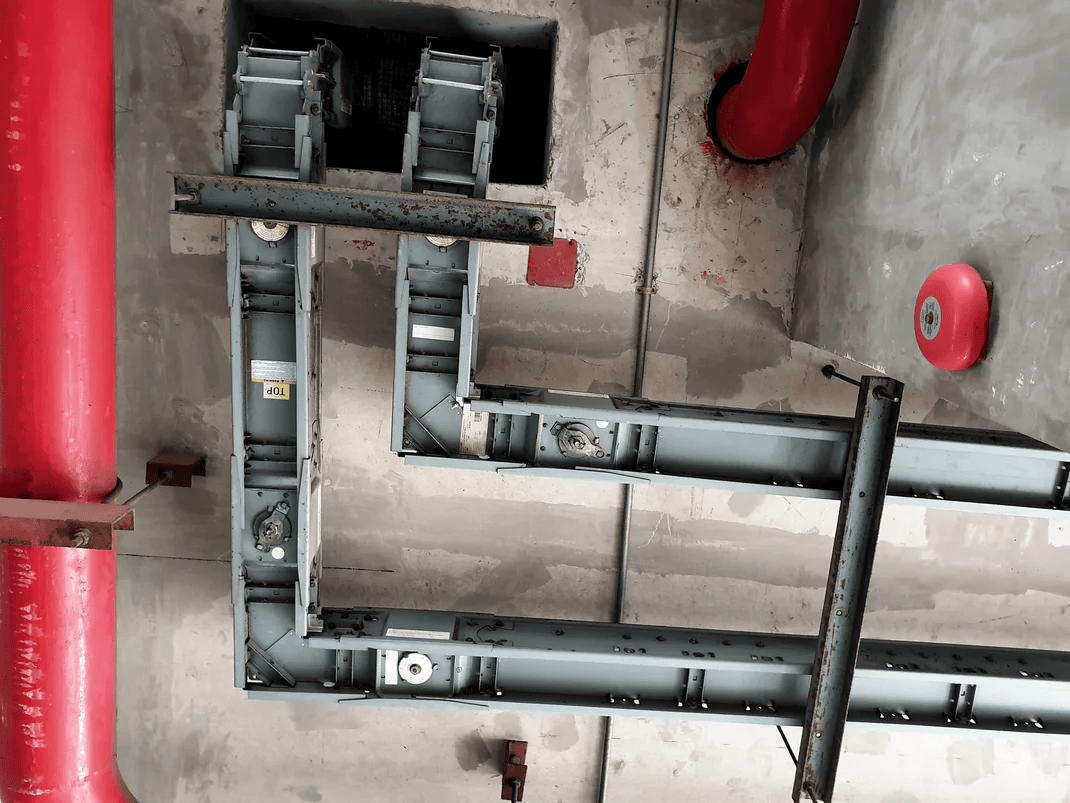
Feeder busway (often referred to as “bus duct”) consists of enclosed busbars designed to carry large amounts of power between major electrical equipment such as switchgear, risers, PDUs, or RPPs. Its role is backbone distribution — not flexible power access.
Track Busway does not manufacture high-amperage feeder bus duct. Feeder busway is used for upstream backbone distribution, while open-slot track busway is deployed downstream to deliver flexible, reconfigurable power where equipment layouts change over time.
Plug-In Busway
Fixed-Window Systems
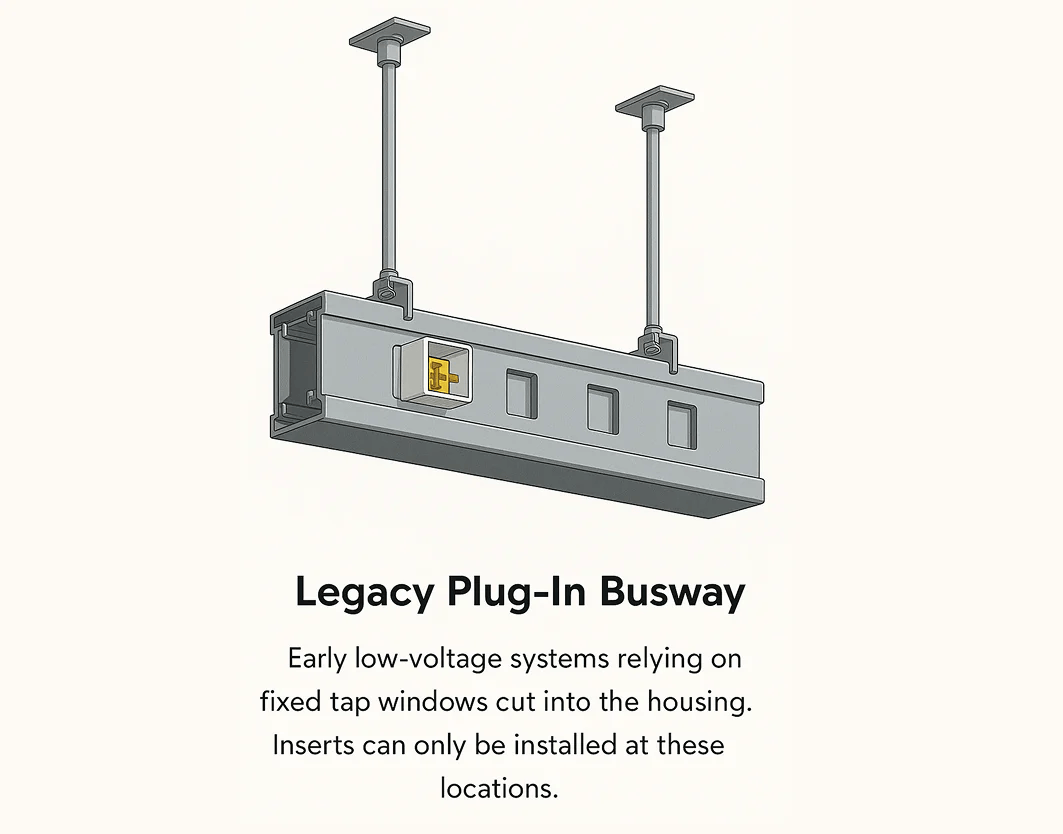
Legacy plug-in busway uses fixed rectangular tap windows spaced at predetermined intervals. Plug-in units must align exactly with these factory-cut openings, which limits device placement and reduces flexibility. While still used in older installations, fixed-window systems are poorly suited for environments that change over time.
Fixed-window plug-in busway represents an earlier generation of distribution; open-slot track busway eliminates these constraints by providing continuous access along the entire run, without predefined tap locations.
Busway Standards and Electrical Specifications
Busway standards define how electrical distribution systems are classified, rated, and applied in commercial and industrial environments. They help engineers and contractors compare voltage range, enclosure type, protection, and plug-in compatibility before specifying a system.
What NEC Article Covers Busway?
Busway is addressed under NEC Article 368, which provides the National Electrical Code framework for how busway systems are applied in electrical installations.
What Is UL 857 Busway?
UL 857 defines busway as a prefabricated electrical distribution system with enclosed bus bars, joints, fittings, and accessories. This helps distinguish busway from conduit and other field-wired methods.
Core Components of a Busway System
A typical busway system includes conductors, housing, insulation, joints, fittings, hangers, and plug-in or tap-off devices. Together, these parts allow power to be distributed through modular sections and expanded over time.
Busway Voltage Classifications
Low-voltage busway generally covers systems up to 600 V, while medium-voltage busway applies to higher-voltage distribution used in more specialized applications.
Construction Styles
Environmental and Enclosure Ratings
Busway systems may be rated for indoor or outdoor use and may be designed for conditions such as dust, moisture, or sprinkler exposure. The enclosure rating helps determine where the system can be safely installed.
Short-Circuit and Interrupt Ratings
Busway systems are evaluated for short-circuit withstand and interrupt performance so engineers can match the system to available fault current and protective device coordination. These ratings are critical when specifying busway for commercial and industrial projects.
Bus Plug Types
Busway systems may use breaker-style plug-in units, fusible disconnect units, or other tap-off devices depending on the required voltage, amperage, and equipment connection method. These devices allow power to be accessed from the busway while maintaining overcurrent protection for the load.
