

Industrial Overhead Power Distribution
Industrial facilities need power that can move with equipment, work cells, and production lines. USA TrackBusway® manufactures overhead plug-in busway systems that bring power above the floor and let teams add or relocate PowerDrops, outlet boxes, lighting, and tap-off units as layouts change.
Use Track Busway for:
- Overhead power distribution near machines, benches, and work cells
- 120V, 208V, 240V, and 480V plug-in power
- PowerDrops, outlet boxes, and tap-off units at the point of use
- Reconfigurable runs that reduce conduit changes and downtime
- Optional lighting on the same overhead busway infrastructure
For industrial teams, modular overhead power distribution keeps electrical access aligned with the process, using movable plug-in tap-off units that can be repositioned as equipment layouts change.
Industrial teams use modular overhead power when equipment, workstations, assembly cells, or production lines need to change without rebuilding fixed conduit paths. USA TrackBusway supports plug-in PowerDrops, outlet boxes, and lighting loads above the workspace so power can stay aligned with the process.
Choosing Industrial Power Access
Industrial runs often use a mix of drop-down power and busway-mounted receptacles. PowerDrop cords bring receptacles closer to machines, tools, benches, and workstations. Outlet boxes keep receptacles mounted directly at the busway.
Breakered plug-in devices can provide local circuit protection where the application requires it.
Check the fit for your machines and environment
Track Busway supports equipment that is relocated between uses. A repositionable PowerDrop is not a traveling conductor system for a crane, hoist, or machine that must move continuously while powered. Describe any powered movement before selecting a connection.
- Load and supply: provide each machine’s voltage, phase, current, duty, starting/inrush requirements, connector and cord reach. Include simultaneous demand and planned additions.
- System and protection: select 40A steel or T225 from the complete load schedule, not amperage alone. T225 remains limited to 225A per phase per run; tap-off, receptacle and protective-device ratings must fit the individual load. The two families’ tap-offs are not interchangeable.
- Environment: the T225 installation manual specifies indoor, horizontal installation. Identify dust, moisture, washdown, chemicals, corrosion, temperature and any hazardous-location classification. Obtain confirmation for the exact product and environment before specification; an open-channel design alone establishes no dust, water or hazardous-location rating.
- Access and support: coordinate approved supports, equipment travel paths, overhead services, cord protection, maintenance access and clearance for inserting and securing tap-offs. Keep T225 tap-offs clear of joints and couplers as directed in the manual.
- Electrical review: confirm available fault current, the marked ratings of the selected assembly, upstream protection, grounding, neutral requirements and voltage drop with the project electrical team.
Qualified personnel must follow the selected system’s instructions for installation and relocation. For T225 inspection, servicing and maintenance, the manual requires de-energizing, lockout/tagout and verification of absence of voltage. Read the T225 installation, operation and maintenance manual and configuration-specific listing guidance.
Send your machine schedule and layout for review. Compare complete installation and future-change estimates using the cost worksheet.

Use the products below to compare 120V, 208V / 240V, and three-phase PowerDrop options. For a broader overview of PowerDrops, outlet boxes, and tap-off units, see Track Busway for Power.

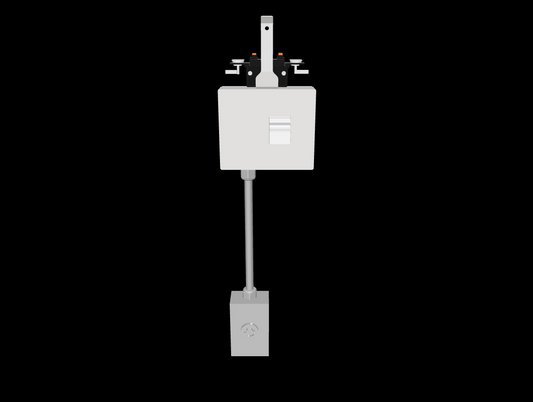


Breakered outlet boxes can be mounted directly to the overhead track when equipment requires local circuit protection or point-of-use receptacle access.
Flexible Overhead Power for Industrial Spaces
USA TrackBusway manufactures open-channel plug-in busway systems for industrial overhead power distribution. Instead of running a new conduit drop each time equipment moves, teams can place approved plug-in devices along the busway run and keep power aligned with machines, benches, racks, and production cells.
A Track Busway layout is built from modular busway sections, feeds, joiners, hangers, and compatible plug-in devices. In industrial facilities, that means PowerDrops, outlet boxes, tap-off units, and lighting adapters can be added or repositioned as production lines, workstations, or equipment zones change.
Compared with traditional bus duct, Track Busway is usually selected for flexible branch-circuit access at the point of use. Feeder bus duct remains useful for backbone power between major electrical equipment, while Track Busway is built for overhead plug-in access where layouts change.
Some drawings or specifications may use the spelling “busduct.” For broader terminology, see Busway Fundamentals.
Industrial Power Layout Options
-
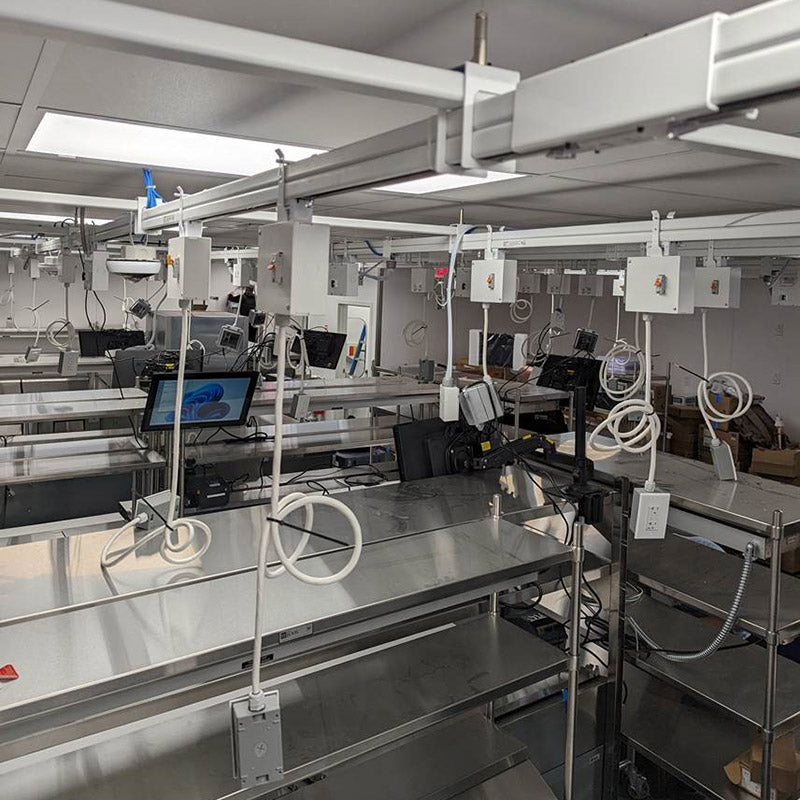
Drop-Down Power for Workstations and Tools
PowerDrop cords bring receptacles down from the overhead busway to the point of use. Use them for tools, benches, assembly cells, test stations, and equipment areas where power needs to hang closer to the workspace.
Shop Power Drop Cords -

40A and 225A Track Busway for Industrial Loads
Use 40A Track Busway for branch-circuit plug-in power. For projects with higher loads, longer runs, or layouts that would otherwise require many 40A feeds, 225A Track Busway provides a higher-capacity overhead busway option.
View 225A Track Busway -

Breakered Outlet Boxes for Local Power Access
Breakered outlet boxes keep receptacles mounted at the busway while providing local circuit protection where the application requires it. Use them when equipment needs power at the overhead run instead of a drop-down cord.
Shop Outlet Boxes


Flexible Power Distribution for Industrial Tasks
Industrial facilities need power that can adapt as equipment, workstations, and production flow change. Track Busway keeps branch-circuit power overhead and accessible, so teams can add or reposition plug-in devices without rebuilding fixed conduit drops.
Use this approach for assembly cells, workbenches, test stations, packaging areas, machinery zones, and industrial tasks where downtime needs to stay low.

Engineered for Manufacturing, Warehouse, and Assembly-Line Environments
USA TrackBusway’s 40A Steel Track system is built with 12-gauge steel for demanding industrial spaces. T225 uses insulated copper conductors in an extruded aluminum housing for higher-capacity applications. Both systems support adaptable overhead plug-in power for equipment and point-of-use loads as operations change.
Common industrial applications include:
- Manufacturing and assembly lines
- Warehouse and logistics areas
- Test benches and work cells
- Research and production facilities
- Automotive and equipment service spaces


Scalable Power for Manufacturing and Assembly Lines
USA TrackBusway systems are engineered to support both current production needs and long-term expansion across industrial facilities:
- 40A and 225A Track Busway Systems:
40A Track Busway is available in single-phase and three-phase configurations. T225 is a three-phase system rated up to 225A per phase. These options allow facilities to match system capacity and configuration to equipment demand without overbuilding infrastructure. - Flexible Voltage & Circuit Access: On three-phase systems, 1-pole, 2-pole, and 3-pole plug-in units allow different voltages to be tapped directly from the same overhead busway — supporting a mix of tools, machinery, and equipment along a single run.
- Reconfigurable Layouts & Intersections: Modular joiners and intersections allow overhead power layouts to evolve as production lines change, keeping power aligned with equipment while minimizing conduit, homeruns, and future labor costs.
For industrial projects with higher loads, longer runs, or layouts that would otherwise require many 40A feeds, the 225A Track Busway system provides a higher-capacity overhead busway option. Manufacturing plants, assembly lines, and logistics facilities can plan power around equipment zones while keeping the flexibility to add or reposition plug-in units as layouts evolve.
Other Flexible Power Applications
-
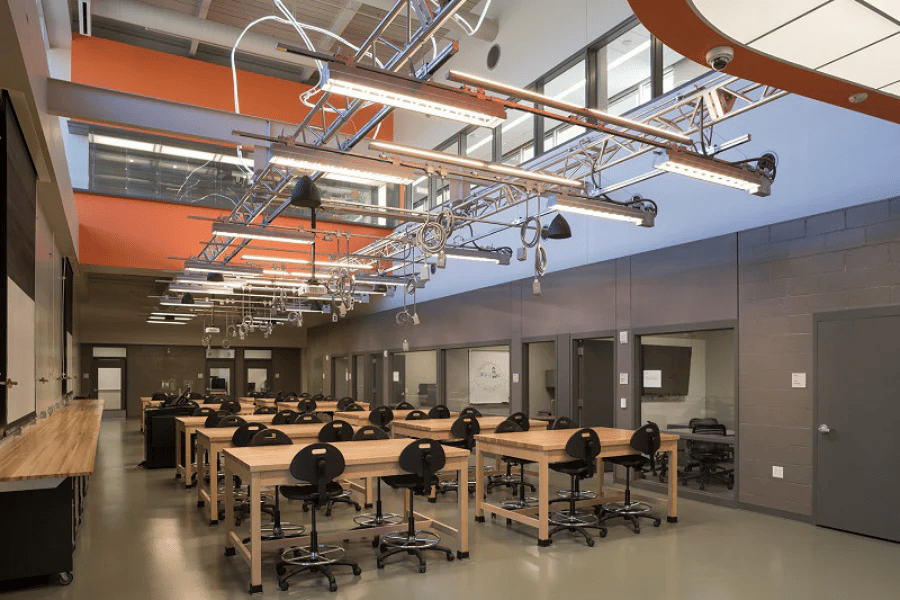
Laboratories
Flexible overhead power for lab benches, equipment zones, and research spaces that may need to be reconfigured.
View Laboratories Track Busway Projects -

Office / Enterprise Workspaces
Overhead plug-in power and lighting for workspaces where furniture, teams, and layouts may change over time.
View Workspace Track Busway Projects -

Automotive
Flexible overhead power for assembly lines, service bays, and production areas that require efficient power distribution.
View Automotive Track Busway Projects -

Data Centers
Reliable overhead power distribution for server racks, network equipment, and evolving data center infrastructure.
View Data Centers Track Busway Projects


Optional Lighting Loads on Industrial Track Busway
USA TrackBusway® enables plug-and-play industrial lighting using the same overhead infrastructure as equipment power, eliminating dedicated conduit runs and reducing installation time with pre-wired fixtures.

Repositionable Lighting as a Secondary Plug-In Load
Compatible industrial lighting fixtures can be added or repositioned at approved locations along the selected busway system as layouts evolve. Check circuit capacity, clearances and the fixture’s connection requirements. Qualified personnel must follow the product-specific installation and relocation instructions, including required isolation and breaker positions.
Image Gallery
Click any image to view full size, or use the arrows to scroll through the gallery.


