

What Is Track Busway?
Track busway is an overhead plug-in busway system that carries power through enclosed conductors and lets compatible tap-off units, drop cords, outlet boxes, and lighting connections plug in along the run. It includes both 40A Track Busway systems and 225A/T225 Track Busway systems, giving facilities flexible power access without rerouting conduit every time equipment, benches, lighting, or workstations move. Learn more about compatible tap-off units and plug-in power devices for Track Busway systems.

Track Busway Definition
In electrical distribution, track busway is a modular overhead power track. Power is fed into the run, enclosed conductors carry it through the track, and compatible plug-in units connect where outlets, drops, lighting, or equipment power are needed.
The easiest way to picture Track Busway is as an overhead power rail. Power is fed into the track, and plug-in devices can be added where power is needed. This allows power drops, receptacles, lighting connections, and equipment connections to move with the layout instead of forcing the layout to follow fixed conduit.
The core idea is simple: install the overhead power backbone once, then move the connection points as the space changes.
Track Busway is commonly used in commercial and industrial facilities where power needs to be flexible, accessible, and easier to reconfigure. For a broader introduction to busway systems, see our Busway Fundamentals guide.
Key Takeaways
- Track Busway distributes power overhead through enclosed conductors inside a track.
- Plug-in units connect along the run to support outlets, drops, lighting, and equipment.
- Power locations can be changed without rerouting conduit for every new connection.
- The system supports flexible layouts in industrial, lab, commercial, office, and retail environments.
How Track Busway Works
Track Busway works by carrying power through conductors inside an overhead track. A feed brings power into the run. Plug-in units then connect to the track wherever power is needed.
In a traditional fixed wiring layout, moving a workstation or piece of equipment can require new conduit, new wire pulls, and downtime. With Track Busway, the power infrastructure stays overhead while the usable connection points can be repositioned along the run.
- Track sections are mounted overhead.
- Feeds bring power into the track.
- Internal conductors carry power along the run.
- Plug-in units connect to supply receptacles, drop cords, lighting, or equipment.
- Power locations can be changed as the layout changes.
This makes Track Busway useful in spaces where equipment, workstations, benches, displays, or lighting layouts change over time.
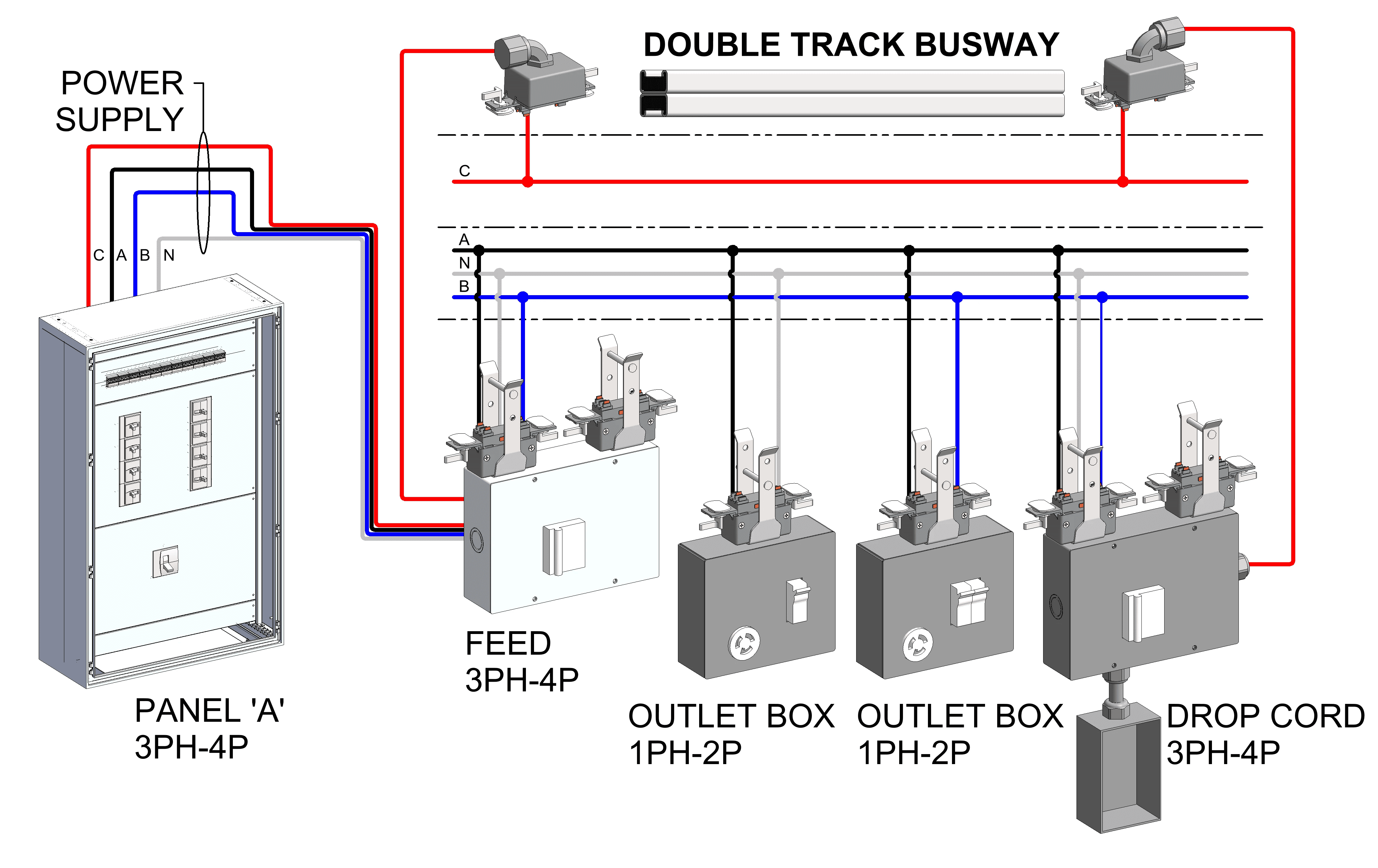
Track Busway System Specifications
Track Busway systems are designed for overhead plug-in power distribution. The exact configuration depends on the facility, voltage, amperage, circuit design, and equipment requirements.
| Field | Typical Value |
|---|---|
| Voltage Compatibility | Up to 600V, depending on system design and selected components |
| Common Configurations | 120V, 208Y/120V, 240V, 277V, and 480V configurations, depending on phase, tap-off, and project requirements |
| Catalog System Families | 40A Track Busway and 225A/T225 Track Busway; selected 40A-system components may be offered as 20A/40A variants |
| Installation Method | Suspended overhead |
| Power Access | Continuous open-slot/open-channel plug-in access along the run |
| Conductors / Housing | 40A systems use steel housings with insulated copper conductors; 225A/T225 uses an extruded aluminum enclosure with insulated U-shaped copper conductors |
| T225 Conductor Options | Standard, Isolated Ground, 200% Neutral, and 200% Neutral + Isolated Ground where specified and supported |
| Safety / Code Context | ETL Listed to UL 857 and designed for NEC Article 368 busway applications; final requirements depend on project design and AHJ review |
| Typical Applications | Manufacturing, laboratories, offices, studios, retail, data centers, mission-critical facilities, and flexible commercial or industrial layouts |
Higher-Capacity 225A / T225 Systems
For higher-capacity layouts, USA TrackBusway’s T225 system is rated 225A per phase and is used where larger equipment loads, rack rows, robotics cells, manufacturing lines, or mission-critical layouts need overhead plug-in access. For projects that need more aggregate capacity across a facility, separate T225 runs can be coordinated through splitter-based layouts or multiple protected sections. A splitter layout does not increase the ampacity of a single T225 run; each run remains rated 225A per phase and must be reviewed against the upstream source, overcurrent protection, conductor configuration, load calculations, voltage system, and project-specific electrical design.
Download detailed Track Busway specifications:
Track Busway Standards and Code Context
Track Busway systems are part of the busway category of electrical distribution equipment. In the United States, busway systems are commonly evaluated under UL 857 and installed in accordance with applicable electrical code requirements, including NEC Article 368 for busways. Final project requirements depend on the system configuration, voltage, amperage, installation conditions, and the local authority having jurisdiction.
Track Busway Installation Overview Video
This overview video shows how Track Busway components come together in a real installation environment.
Benefits of Track Busway
Track Busway is valuable because it makes power distribution easier to adapt. Instead of treating every outlet or drop as a fixed location, the system lets facilities move connection points as needs change.
- Flexible plug-in access – Compatible tap-off units, drop cords, outlet boxes, and lighting adapters can be added or repositioned along the open slot as layouts change, reducing the need to run new conduit for every connection. All changes should use compatible components and follow code, load, and project requirements.
- Less rewiring – Layout changes do not require a new conduit run for every connection.
- Reduced downtime – Facilities can reconfigure power with less disruption.
- Faster installation – Pre-engineered sections can reduce field wiring complexity.
- Cleaner overhead layouts – Power distribution is organized in one overhead system.
- Scalable design – Additional plug-in units can be added as facility needs change.

Main Parts of a Track Busway System
A Track Busway power distribution system includes the parts needed to carry power overhead and deliver it to usable connection points.
Track Busway layouts are built from straight pre-wired sections, feeds, electrical and mechanical joiners, suspension hangers, end caps or closure accessories, and compatible plug-in units. Instead of assuming elbows or tee sections, USA TrackBusway layouts are typically planned as ROWs, RECTANGLEs, GRIDs, BRIDGEs, or multiple coordinated runs using feeds and joiners to place power where it is needed
Track Sections
Track sections, also called runs, carry power along the overhead path. They contain insulated conductors inside a durable housing.
Feeds
Feeds bring power into the Track Busway system and connect the overhead run to the electrical source.
Joiners and Hangers
Joiners connect track sections together. Hangers support the system overhead and keep the run properly positioned.
Plug-In Units
Plug-in units connect to the track and deliver usable power to outlets, drops, lighting, or equipment.
Track sections are available through the RUNs collection, and power input components are available through the FEEDs collection.
Track Sections
Pre-wired tracks act as the overhead power pathway. They carry power through enclosed conductors and provide plug-in access along the run.

Factory-Installed Fittings
Factory-installed fittings help plug-in devices connect to the conductors inside the track. These fittings support secure electrical connection points along the run.
Linear Mounting Kit

Busway Fitting

Plug-In Units
Plug-in units are the devices that make Track Busway flexible. They can provide receptacles, drop cords, lighting adapters, or equipment connections where power is needed.

Track Busway vs Bus Duct vs Conduit
Track Busway, traditional bus duct, and conduit all distribute electrical power. The difference is how flexible the system is after installation.
Track Busway vs plug-in busway
| Feature | Track Busway | Traditional Bus Duct | Conduit |
|---|---|---|---|
| Power Access | Plug-in access along the run | Usually fixed tap-off windows | Fixed outlet or junction box locations |
| Layout Changes | Plug-in units can be moved | Changes are more limited | Often requires rewiring or new conduit |
| Best Use Case | Flexible spaces with changing layouts | Planned high-capacity distribution | Permanent branch circuits |
| Installation Impact | Designed for modular expansion | Requires planned tap points | Labor-intensive changes |
Track Busway vs bus duct
Traditional bus duct systems usually distribute power through enclosed busbars with tap-off windows placed at set locations. Track Busway is different because it supports continuous plug-in access along the run. That makes it easier to add or relocate power drops when the facility layout changes.
Track Busway vs conduit
Conduit is effective for permanent wiring, but it can be harder to change. If a workstation, bench, display, or machine moves, the electrical layout may need to be reworked. Track Busway is designed to reduce that friction by keeping the power pathway overhead and allowing plug-in units to move with the layout.
How is Track Busway different from conduit, cable trays, or plug strips?
Conduit routes individual conductors, cable trays support cable pathways, and plug strips provide localized outlet access. Track Busway is an overhead busway system with compatible plug-in units, so power access can be added or moved along the run as layouts change. Learn more about busway system or Track Busway, plug-in units, and power access or drop cords.
Where Track Busway Is Used
Track Busway is most useful in facilities where power locations may change over time.
- Manufacturing and industrial areas: Equipment rows, work cells, robotics, and changing production layouts.
- Data centers and mission-critical facilities: Rack rows, colocation suites, AI/HPC layouts, server rooms, and phased power expansion where T225 and project electrical design are appropriate.
- Laboratories: Flexible benches, instruments, pilot production, and overhead power drops.
- Offices and studios: Open ceilings, changing workstation layouts, lighting, and equipment power.
- Retail and commercial spaces: Displays, seasonal layouts, lighting, and flexible overhead receptacles
- Automotive and testing environments: Bays, automation cells, tools, and equipment zones that may change over time.

Planning a Track Busway System
Before selecting components, map the overhead path, identify the layout type, and confirm where equipment, benches, racks, lighting, or workstations need power. Then calculate expected loads, select the voltage and phase configuration, choose the appropriate 40A or 225A/T225 system family, and match feeds and tap-off units to the project requirements.
Use the Product Buyer’s Guide and Choose Your System page to compare system families, or request Free Project Drawings for layout support.
Frequently Asked Questions About Track Busway
What is a Track Busway in simple terms?
Track Busway is an overhead power track that lets compatible plug-in devices connect along the run. It provides power without requiring a new conduit run for every outlet, drop, or lighting connection.
How is Track Busway different from conduit?
Conduit is usually fixed once installed. Track Busway is designed for flexible power access, so plug-in units can be added or moved as the space changes.
How is Track Busway different from bus duct?
Traditional bus duct often uses fixed tap-off locations. Track Busway uses a continuous plug-in design, which allows more flexible placement of power connections.
Can Track Busway be reconfigured after installation?
Yes. Compatible plug-in units can be added, removed, or repositioned along the track without rewiring the entire system.
What voltages are supported?
Single-phase and three-phase configurations up to 600V are supported, depending on the system design and project requirements.
Is Track Busway safer than conduit?
Track Busway is designed with enclosed conductors and controlled plug-in access points. Final safety depends on proper system design, installation, code compliance, and use of compatible components.
Where is Track Busway commonly used?
Track Busway is commonly used in industrial facilities, laboratories, offices, retail spaces, and other environments where power layouts need to change over time.
Summary
Track Busway is a flexible overhead plug-in busway system. It distributes power through an enclosed track and allows compatible plug-in units to be added or moved along the run.
For facilities that need reconfigurable power, Track Busway can reduce rewiring, support faster layout changes, and keep power distribution organized overhead.
Need help planning a Track Busway layout? Contact USA TrackBusway to discuss your project.
