Track Busway for Power
Access power from USA TrackBusway with plug-in PowerDrops, outlet boxes, and tap-off units designed for overhead layouts.
Choose the right power-access method based on voltage, receptacle type, breaker requirements, cord length, and where equipment needs power along the run.

Supplying Power Where You Need It
Track Busway provides suspended power distribution that delivers reliable electrical connections directly above the workspace. Because power is supplied overhead, equipment can be repositioned without cutting conduit or pulling new wiring.
By delivering power exactly where it is needed, Track Busway reduces floor congestion, long cord drops, and wall-mounted outlet limitations. This makes the system ideal for environments where layouts change frequently and power access must remain close to the point of use.
What Is a Busway Tap-Off Box?
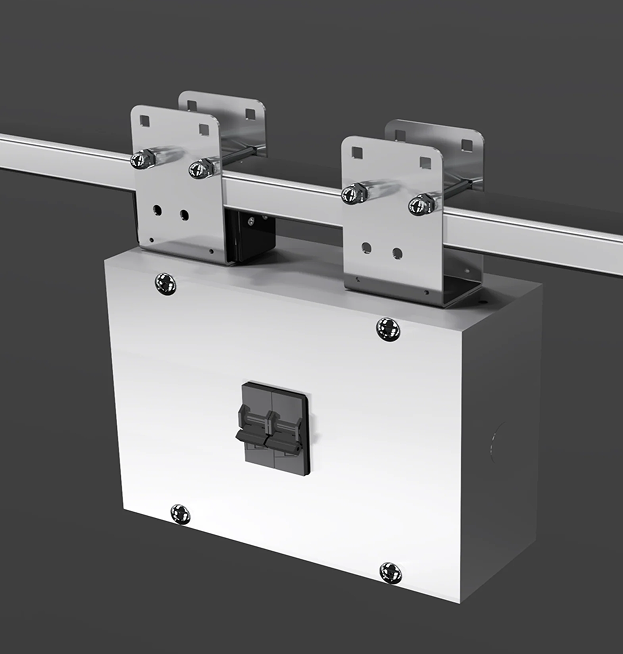
A busway tap-off box is a plug-in unit that connects to the busway conductors and delivers branch-circuit power to equipment, receptacles, or drop cords. In Track Busway layouts, tap-off boxes may be configured as outlet boxes or breakered drop-cord assemblies. Some users may also refer to this type of component as a busway tap box.
Power Drops and Outlet Boxes
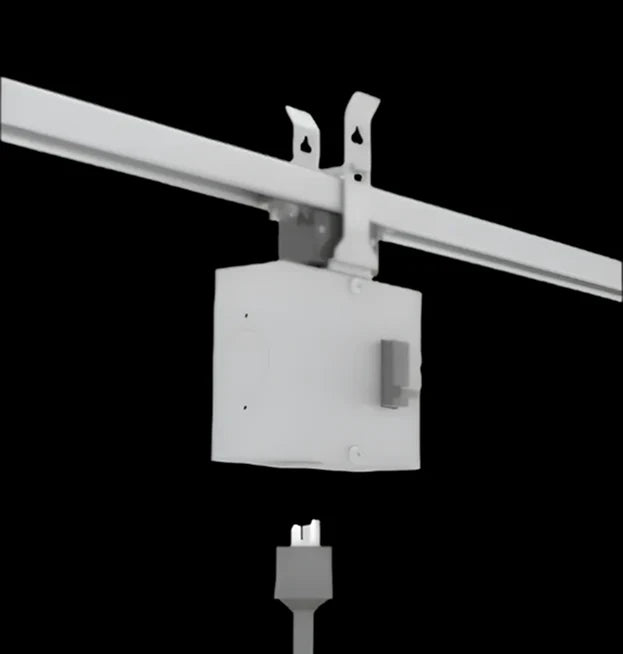
Power Drops bring receptacles down from the overhead busway to the point of use.
Outlet boxes keep receptacles mounted at the busway.
Need a product path? Shop by format: Outlet Boxes | Drop Cords

Because these plug-in devices deliver power from the overhead busway to nearby equipment, contractors may refer to them as tap-off units, tap-off boxes, bus plugs, or busway tap boxes.
For additional installation scenarios, configuration examples, and system overviews, visit the Track Busway Video Library →
Busway Plug-In Units and Power Drops Explained
Track Busway systems distribute electrical power through overhead busway runs installed above work areas. Plug-in units—often referred to as tap-off boxes or power drops—connect directly to the busway and allow power to be delivered safely and efficiently to equipment below.
Because these plug-in units can be repositioned anywhere along the busway, they provide a flexible alternative to traditional hard-wired power distribution systems.
If you are comparing bus duct or busduct options, start with bus duct vs Track Busway: traditional feeder bus duct is often used for backbone distribution, while Track Busway is strongest where flexible plug-in access, tap-off boxes, and power drops need to be positioned overhead.

Open-Slot Busway Design
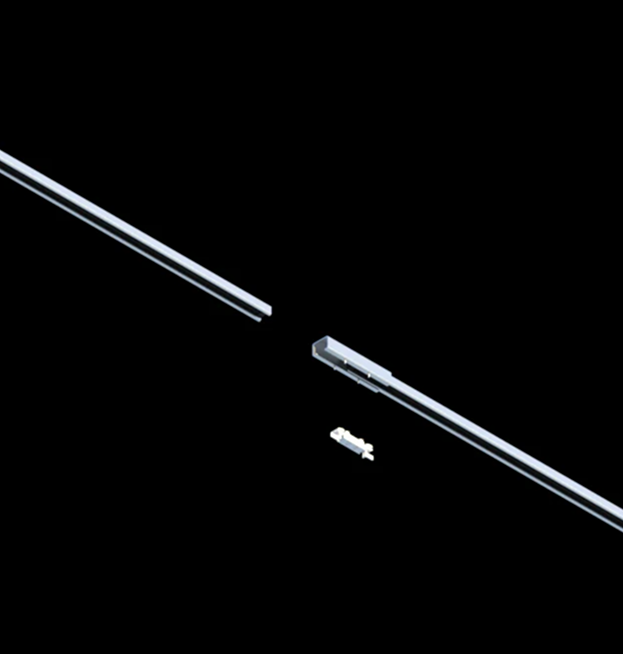
Track Busway uses a continuous open-slot design with insulated copper conductors housed inside a steel channel. This allows plug-in devices to access power anywhere along the run, rather than at fixed tap-off points.
Unlike conduit or fixed-window busway, open-slot access supports faster installation, easier expansion, and fewer homerun feeds — all while remaining code-compliant under UL 857 and NEC Article 368.
Busway Plug-In Unit Wiring Configurations
These diagrams show how Track Busway plug-in units connect to the internal conductors and deliver power to equipment below. Each configuration corresponds to a specific voltage and phase arrangement, allowing the system to support a wide range of applications.

Panelboard ‘A’ may be 120/208V or 277/480V depending on building service.

Available: 208/480V

Line to Neutral Available: 120/277V

Line to Line Available: 1Ph-208V or 1Ph-480V
Available: 208/480V
1-Pole, 2-Pole, and 3-Pole power taps on the 4-Pole (3-Phase Busway).
Pole count refers to the internal breaker configuration of the plug-in unit, not the physical track.
- 1-Pole tap-offs connect one hot and the neutral to deliver 120V (line-to-neutral)
- 2-Pole tap-offs connect two hots (no neutral) to deliver 208V single-phase or 240V (line-to-line)
- 3-Pole tap-offs engage all three hots and the neutral to support 208V or 480V three-phase, four-wire configurations
For example, a 3-pole plug-in may be installed on a four-conductor (3-phase, L-L-L-N) Track Busway to serve three-phase loads with a neutral present.


Standard Track Busway Configurations
Track Busway systems can be arranged in several overhead layouts depending on the workspace and equipment requirements. These configurations allow power to be distributed above work areas while maintaining flexible access for plug-in devices.
Choose the configuration that best matches your project layout:
-
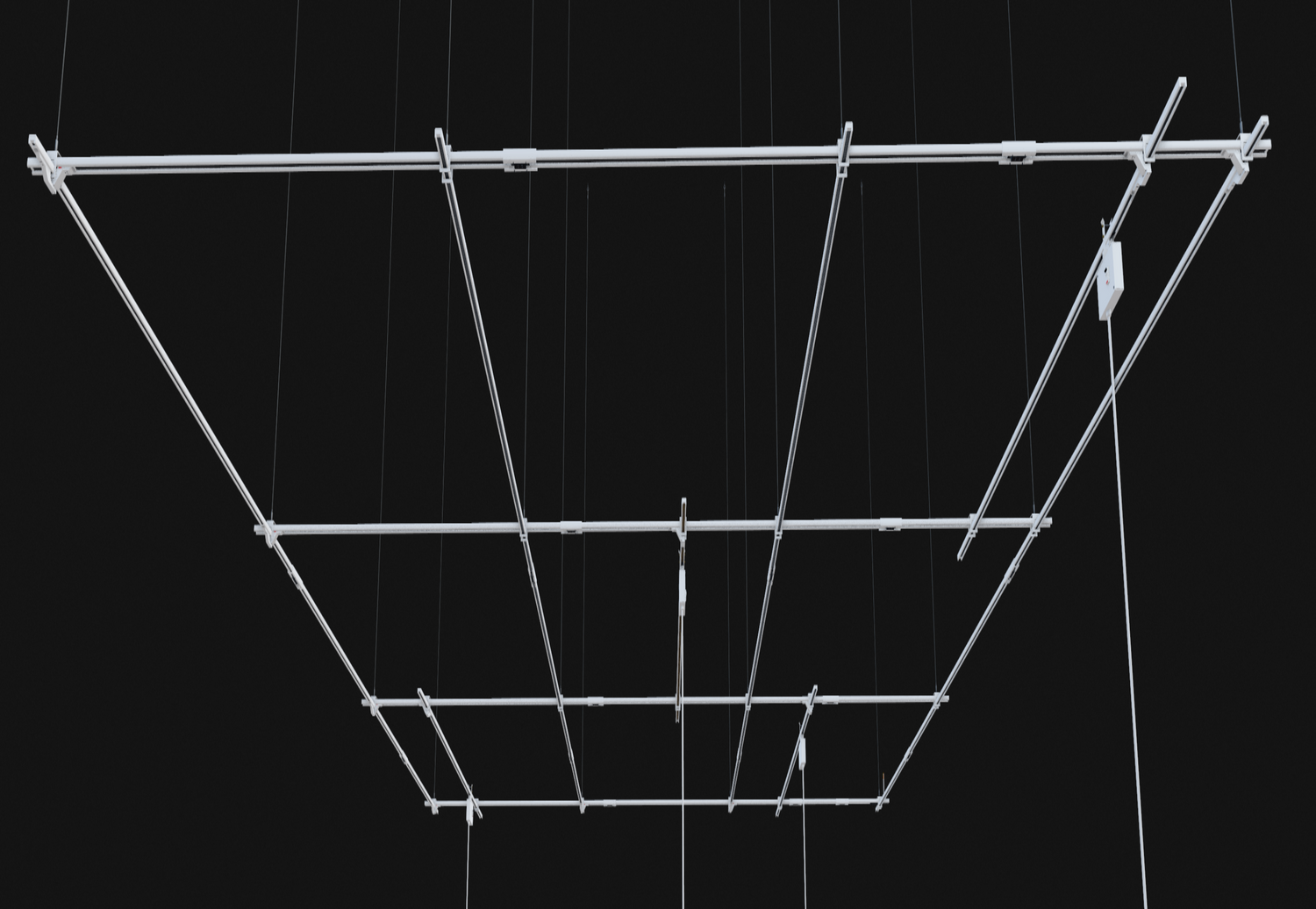 GRID
GRIDGRID configurations create evenly distributed overhead power across large areas. Ideal for facilities that require uniform coverage, GRIDs reduce homerun feeds and support flexible placement of power drops throughout the space.
-
 RECTANGLEs
RECTANGLE layouts provide structured perimeter and interior coverage for defined work zones. This configuration is commonly used where power needs to be evenly distributed around equipment, benches, or production areas.
-
 ROWs
ROWsROW configurations deliver linear overhead power directly above workstations or equipment lines. ROWs are ideal for targeted power distribution in manufacturing cells, labs, and retail environments.